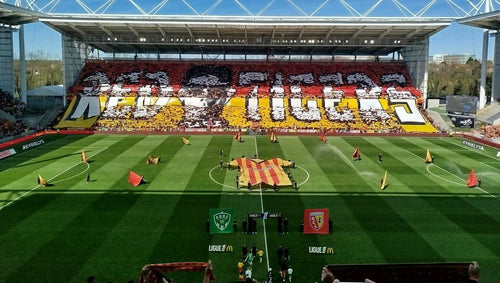
Europe is the continent of football. Its stadiums are cathedrals, places of pilgrimage for millions of supporters. From Wembley to San Siro, from Anfield to Signal Iduna Park — here is our selection of the 15 European stadiums that are absolutely worth the trip.
Why travel for a stadium?
A football match in a large foreign stadium is about much more than a match. It's an immersion in a culture, an encounter with supporters of a different mentality, a total sensory experience. The sound is different, the chants are different, the atmosphere is different.
Groundhoppers — enthusiasts who collect the stadiums they have visited — know better than anyone: every stadium has a soul. And some stadiums have an exceptional soul.
🏆 Our Top 15 European stadiums
🏟️ 1. Anfield — Liverpool, England
Capacity: 61,276 seats | Club: Liverpool FC
The most moving stadium in Europe. Before every match, 60,000 people sing "You'll Never Walk Alone" — the song from the musical Carousel that became the anthem of world football. You get goosebumps, even if you're not a Reds fan.
The Kop — the historic standing section — is a wall of supporters that never stops singing. Champions League nights at Anfield are legendary: the comeback against Barcelona (4-0 in the 2019 semifinal), the victory against AC Milan in 2005...
🎵 The unique experience: Arrive 45 minutes before kickoff to experience "You'll Never Walk Alone" in its entirety from the stands. It's a moment you'll never forget.
🏟️ 2. Signal Iduna Park — Dortmund, Germany
Capacity: 81,365 seats | Club: Borussia Dortmund
The Yellow Wall. 25,000 standing places on one side alone — the largest supporters' wall in Europe. When BVB play at home, the Südtribüne transforms into a yellow-and-black mass that sways, sings, and vibrates in unison. The noise is physical — you feel it in your chest.
Borussia Dortmund's ultras are among the most impressive on the continent. Their tifo (a display in the stands with flags and banners) rivals the finest in the world.
🏟️ 3. Camp Nou — Barcelona, Spain
Capacity: 99,354 seats | Club: FC Barcelona
The largest stadium in Europe. "Més que un club" — more than a club. FC Barcelona is as much a cultural and political institution as it is a sporting one. Camp Nou embodies this DNA: monumental, historic, vibrating with a passion that transcends football.
The "Clásicos" against Real Madrid at Camp Nou are the most publicized matches in the world. The atmosphere, the Catalan chants, the dull roar of the 99,000 spectators — an experience in itself.
🏟️ 4. Wembley Stadium — London, England
Capacity: 90,000 seats | English national stadium
The Wembley Arch, visible from all over London. The temple of world football. Built in 2007 on the ruins of the legendary original Wembley, the new stadium inherited all the history of its predecessor: the 1966 World Cup final, FA Cup finals, and legendary concerts.
Wembley hosts the FA Cup finals, England national team matches, and some Champions League finals. It is an absolute place of pilgrimage for every football lover.
🏟️ 5. San Siro — Milan, Italy
Capacity: 75,923 seats | Clubs: AC Milan + Inter Milan
One of the few stadiums in the world shared by two major rival clubs. San Siro — officially Stadio Giuseppe Meazza — is an architectural monument with its distinctive cylindrical towers and spiral ramps. Inaugurated in 1926, it exudes the history of calcio.
The Derby della Madonnina between AC Milan and Inter is one of the most electric matches in Europe. Two colors, two philosophies, one stadium — 76,000 people divided in two.
🏟️ 6. Allianz Arena — Munich, Germany
Capacity: 75,024 seats | Club: Bayern Munich
The Munich "bubble." In the evening, the Allianz Arena's facade lights up in white, red, or blue depending on which team is playing — a spectacle visible from miles away. Inside, it is one of the most modern and best-organized stadiums in the world.
Bayern Munich plays there in immaculate surroundings. German efficiency applied to football: punctuality, cleanliness, perfect organization — and a pitch that's always in perfect condition.
🏟️ 7. Old Trafford — Manchester, England
Capacity: 74,879 seats | Club: Manchester United
"The Theatre of Dreams." Sir Alex Ferguson. George Best. Bobby Charlton. Denis Law. Cristiano Ronaldo. Wayne Rooney. Old Trafford has welcomed the greatest names in world football for more than 100 years.
The Manchester United museum at Old Trafford is one of the finest football museums in the world. The Holy Trinity statue (Best, Law, Charlton) at the stadium entrance is iconic. A mandatory pilgrimage for every football fan.
🏟️ 8. Estádio da Luz — Lisbon, Portugal
Capacity: 64,642 seats | Club: SL Benfica
Benfica's stadium, built for Euro 2004, is an architectural gem that fits perfectly into Lisbon's landscape. The "Encarnados" create a warm and passionate atmosphere — Portuguese football has a special soul.
Lisbon is also a magnificent city to explore. Combining a match at the Luz with a few days in the Portuguese capital makes for a perfect trip.
🏟️ 9. Celtic Park — Glasgow, Scotland
Capacity: 60,411 seats | Club: Celtic FC
"Paradise." That's Celtic Park's nickname, and it is well deserved. Celtic's European match atmosphere is legendary — the Green Brigades with their flags, the Irish songs echoing around the stadium, the raw passion of a club that embodies far more than football.
The Celtic-Rangers Old Firm derby is considered one of the most intense matches in the world. Two religions, two political identities, a century-old rivalry.
🏟️ 10. Santiago Bernabéu — Madrid, Spain
Capacity: 81,044 seats | Club: Real Madrid
Completely renovated between 2019 and 2023, the Bernabéu is now one of the most technologically advanced stadiums in the world: retractable roof, retractable pitch, spectacular illuminated facade. "The House of Champions" — 14 European Cups, more than any other club.
Stadiums 11 to 15 — Not to be overlooked
📋 Stadiums 11 to 15
| Rank | Stadium | City | Specialty |
|---|---|---|---|
| 11 | Johan Cruyff Arena | Amsterdam | Total football, Ajax heritage |
| 12 | Stamford Bridge | London | Intimate atmosphere, a century of history |
| 13 | Olimpico | Rome | Roma-Lazio derby, Roman architecture |
| 14 | Volksparkstadion | Hamburg | Authentic German football |
| 15 | Estadio do Dragão | Porto | FC Porto European nights |
How to organize your European stadium tour
By country — recommended circuits
England Circuit (5 days): London (Wembley, Stamford Bridge, Emirates) → Manchester (Old Trafford, Etihad) → Liverpool (Anfield). Take the train between the cities.
Germany Circuit (4 days): Munich (Allianz Arena) → Dortmund (Signal Iduna Park) → Frankfurt (Deutsche Bank Park). Deutsche Bahn connects all these cities.
Iberian Circuit (5 days): Barcelona (Camp Nou) → Madrid (Bernabéu) → Porto (Dragão) → Lisbon (Estádio da Luz). Low-cost flights between the cities.
The realistic budget
- Flight ticket: €50 to €200 round-trip (Ryanair, EasyJet, Vueling)
- Match ticket: €30 to €150 depending on the club and seating
- Accommodation: €40 to €100/night depending on the city
- Total stadium weekend budget: €150 to €500/person
Track your progress across Europe
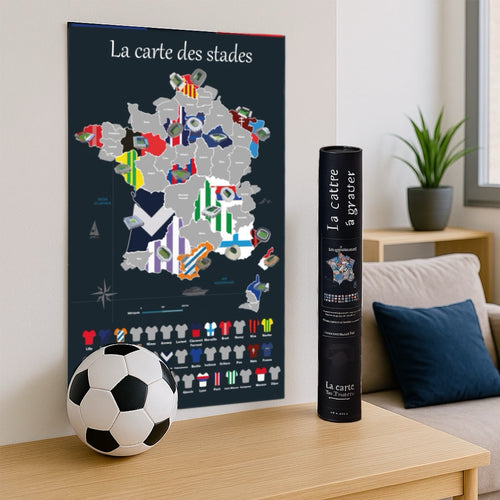
If you aspire to visit Europe's greatest stadiums, the Europe Stadium Scratch Map is your ideal companion. It features 220 stadiums across 10 European countries. After each visit, you scratch off the stadium and watch your map fill up.
It's a challenge that can take years — and that's exactly what makes it exciting. Every scratched-off stadium is a memory, a story, an adventure.
🌍 Ready to start your European adventure? Discover the Europe Stadium Scratch Map — 220 stadiums to scratch off across 10 countries, 60×50 cm poster format, delivery within 48 hours.