Some stadiums are not simply pitches surrounded by stands. They are places of legend, cathedrals of football steeped in history, emotion and culture. Here are the stadiums that every football enthusiast should have visited at least once in their life.
What makes a stadium "legendary"?
A legendary stadium brings together several dimensions:
- The history - matches that changed football were played there
- The atmosphere - a unique collective emotion, impossible to reproduce elsewhere
- The architecture - a recognizable design that forms part of the cultural heritage
- The myth - stories, legends, moments that belong to global popular culture
By these criteria, a few stadiums stand out decisively. Here they are.
🌍 Europe's legendary stadiums
🏟️ Anfield - Liverpool, England
Capacity: 61,276 seats | Since: 1884
There are places where football becomes something greater than sport. Anfield is one of them.
Before every match, 60,000 people raise their scarves and sing "You'll Never Walk Alone". The original song from the 1945 musical Carousel became the anthem of world football thanks to Liverpool. This moment - raised scarves, united voices, the glow of the floodlights - is one of the most moving spectacles sport has to offer.
Legendary moments:
- The 1977 European Cup final against Borussia Mönchengladbach
- The Miracle of Istanbul (2005) - 3-0 at halftime against AC Milan, Liverpool came back to win on penalties
- The Remontada against Barcelona in 2019 - 4-0 after losing 3-0 in the first leg
- The 2020 English league title after a 30-year wait
🎵 The experience not to miss: Arrive 1 hour before kickoff. Take your place in the Kop. Close your eyes when "You'll Never Walk Alone" begins. Open them when 60,000 voices sing in unison. It is a transformative moment.
🏟️ Signal Iduna Park - Dortmund, Germany
Capacity: 81,365 seats | Since: 1974
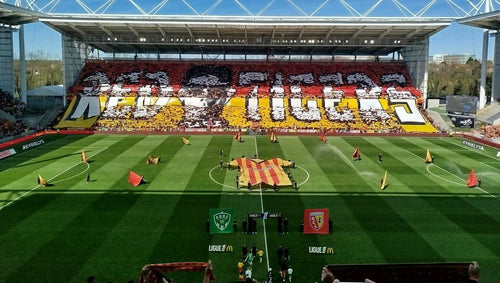
The Yellow Wall. The Südtribüne. 25,000 standing places on one side alone - the largest supporters' wall in Europe. When Borussia Dortmund's ultras take center stage with their yellow and black flags, it is a visual and sonic spectacle unlike any other.
The noise at Signal Iduna Park is physical - you feel it in your chest. Not just in your ears. The stadium literally vibrates on big occasions. On Champions League nights, the atmosphere ranks among the best in the world.
What makes it unique: The cohesion of BVB supporters. Despite an 81 000-seat stadium, the Südtribüne creates a unity and intensity that few stadiums can match. And Borussia's tifos (stand displays) are among the most beautiful in the world.
🏟️ San Siro — Milan, Italy
Capacity: 75 923 seats | Since: 1926
The old lion of calcio. Officially "Stadio Giuseppe Meazza", San Siro is one of the few stadiums shared by two great rivals - AC Milan and Inter Milan. Its spiral architecture, cylindrical towers and access ramps make it instantly recognisable.
San Siro is steeped in history: Ronaldo, Maldini, Baresi, Van Basten, Gullit, Zanetti... The greatest names in world football have graced this pitch. The Derby della Madonnina is one of Europe's most electric matches - 76 000 people divided into red and black on one side, blue and black on the other.
Tip: San Siro is due to close in the coming years to make way for a new stadium. Go before it's too late.
🏟️ Camp Nou — Barcelona, Spain
Capacity: 99 354 seats | Since: 1957
The largest stadium in Europe. "Més que un club." FC Barcelona is as much a political and cultural institution as it is a sporting one - and Camp Nou is its temple. During the Franco dictatorship, speaking Catalan was forbidden. Camp Nou became one of the few places where Catalans could express their identity freely. Football as cultural resistance.
Today, watching a "Clásico" between Barcelona and Real Madrid at Camp Nou remains one of the most intense football experiences in the world. 99 000 people, a century-old rivalry, the best football on the planet.
🏟️ Wembley — London, England
Capacity: 90 000 seats | Since: 2007 (original 1923)
The Wembley arch, visible from all across London. The 1966 World Cup final — "They think it's all over... it is now !" The hymn "Abide with Me" before every FA Cup final. Wembley is football's living history, continuing to be written.
The new Wembley, opened in 2007, inherited all the magic of the original. Its immaculate pitch, monumental capacity and flawless organisation make it one of the best stadiums for major occasions.
🌎 The world's legendary stadiums
🏟️ Maracanã — Rio de Janeiro, Brazil
Current capacity: 78 838 seats | Since: 1950
The most legendary of them all. The "Mãe dos Estádios" — the Mother of Stadiums. The Maracanã welcomed 199 854 spectators during the 1950 World Cup — the all-time attendance record at a football stadium. This figure will never be surpassed.
The "Maracanazo" - Brazil's defeat to Uruguay in the 1950 World Cup final - is one of the most traumatic moments in the history of sport. Thousands of Brazilians wept in the stands. Legend has it that some died of heartbreak.
64 years later, the Maracanã experienced another trauma: Germany's 7-1 victory over Brazil in the 2014 World Cup semi-final. Two national catastrophes in the same stadium - the Maracanã carries the history of Brazilian football in all its greatness and all its pain.
🏟️ La Bombonera - Buenos Aires, Argentina
Capacity: 49,000 seats | Since: 1940
"La Bombonera no tiembla, late" - it doesn't shake, it beats like a heart. Legend has it that Boca Juniors' stadium physically vibrates during matches - and it's true. Its unique asymmetrical design, with an almost vertical stand on one side, creates measurable vibrations.
The atmosphere at La Bombonera during a Boca-River Superclásico is considered the most intense in the world. This isn't football - it's a religion, a war, a celebration and passion all combined into 90 minutes.
France's legendary stadiums
🇫🇷 Our French selection
| Stadium | Club | What makes it legendary |
|---|---|---|
| Bollaert-Delelis | RC Lens | Best atmosphere in France, the quintessential people's stadium |
| Orange Vélodrome | OM | 67,000 seats, the largest, Marseille passion |
| Geoffroy-Guichard | ASSE | "The Cauldron", unique acoustics, glorious history |
| Parc des Princes | PSG | Parisian temple, electric European nights |
| Stade de France | France national team | 81,000 seats, 1998 World Cup final |
How to visit these legendary stadiums
Guided tours - visiting even without a match
Most major stadiums offer guided tours that provide access behind the scenes - dressing rooms, players' tunnel, pitch, press room. It's a complete experience in its own right, often very well done:
- Anfield - tour + LFC museum, around £25
- Camp Nou Experience - the most visited stadium tour in Europe
- Orange Vélodrome - tour + OM museum, around €15
- Parc des Princes - tours available on weekdays, around €20
Planning your stadium bucket list
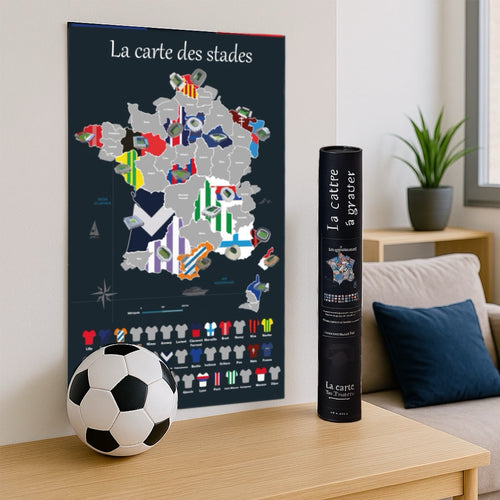
If you want to set yourself the goal of visiting these legendary stadiums, The Europe Stadium Map covers the 220 largest European stadiums - including most of the stadiums on this list. After each visit, scratch off the stadium and watch your progress.
🌍 Ready to start your stadium bucket list? Discover The Europe Stadium Map - 220 European stadiums to scratch off, 60×50 cm format, delivered within 48 hours in a protective tube.